Connect Manus AI to Google Ads with LoomaScale
Connect Manus AI to Google Ads by adding LoomaScale as a custom MCP connector and signing in with OAuth. Analyze live campaigns and make supported changes through the permissions you grant. No code or Google Ads developer token is needed. Save the required project instructions below before starting chats.
Updated
Connection overview
- Connect Google Ads in LoomaScale and select your default customer account.
- Open Plugins → Create → Add MCP by URL and enter the LoomaScale server details.
- Choose Save and Publish → Publish to Projects, then create or choose your project.
- Required: save the full project instructions before publishing LoomaScale to that project.
- Confirm the project publication, choose Connect, and authorize your LoomaScale account.
- Select the project in a new task, verify the Google Ads account with a read-only prompt, then review an analysis.
Required before you start a chat Save these instructions in your Manus Project before starting a chat. Adding the connector alone does not ensure Manus invokes LoomaScale: it may otherwise choose its native Google Ads or Meta Ads connectors. Enable LoomaScale for the project and keep your ad-related chats inside that project.
What you need before you start
- A Manus account with custom MCP access. Check current plan eligibility in Manus.
- A LoomaScale account with Google Ads connected and a daily spend cap configured.
- Google Ads customer-account access, directly or through a manager account (MCC).
First, connect your Google Ads customer account in LoomaScale
Open Connections in LoomaScale, connect Google Ads, and authorize your Google login. Select the default customer account and set its daily spend cap. With an MCC, choose a client account: manager accounts do not hold campaigns. Note the customer ID.
Open LoomaScale connectionsConnect Manus, step by step
Open Plugins in Manus
Open the Manus sidebar and choose Plugins. This is where you add the LoomaScale connector.
Open Manus connectors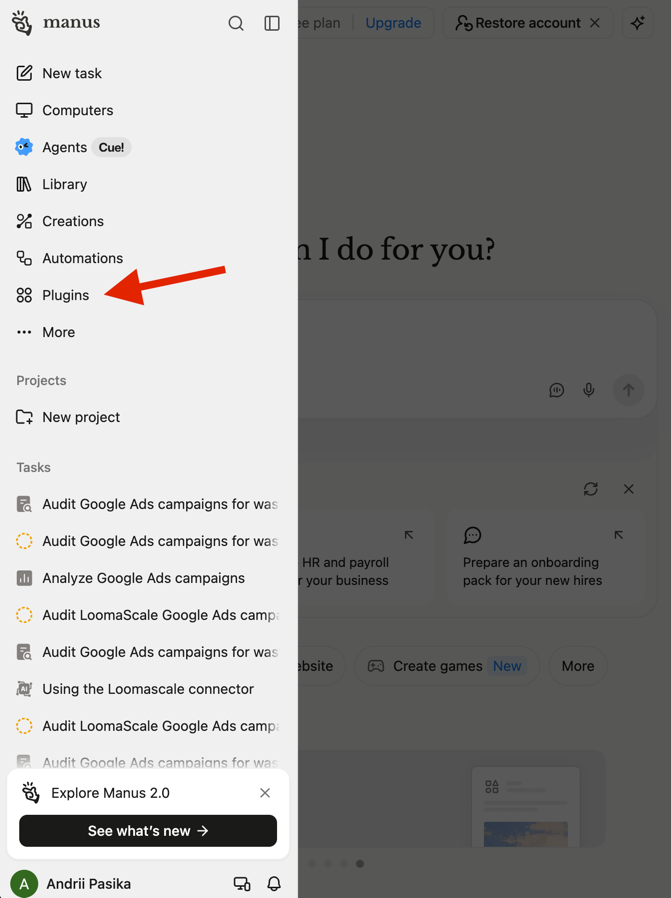
Open Plugins from the Manus sidebar. Choose Add MCP by URL
On the Plugins page, open Create and choose Add MCP by URL. If LoomaScale is already connected, use its existing connector: confirm it is published to your chosen project and complete the required instructions in step 6 before starting a chat.
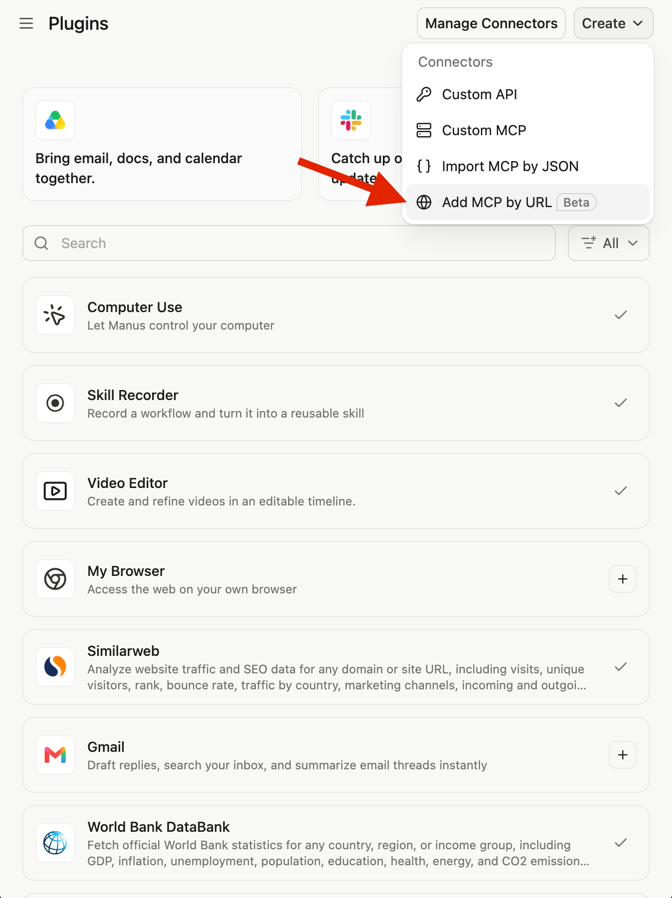
Choose Create, then Add MCP by URL. Enter LoomaScale and publish to a project
Enter LoomaScale in Server name and paste the Server URL below. Keep advanced settings at their defaults. Open the Save and Publish menu and choose Publish to Projects to make the connector available in your project.
Server name in Manus
LoomaScale
Server URL in Manus
https://api.loomascale.com/mcp
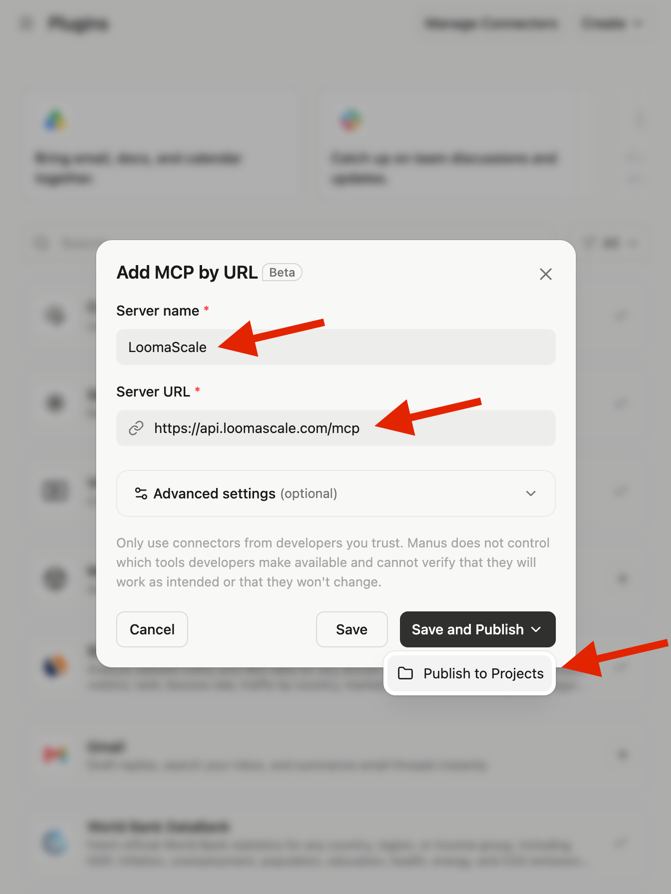
Enter the server details, then choose Save and Publish → Publish to Projects. Create or choose your Manus project
In Publish to Projects, choose Create new if you do not have a project yet. If you already have one, use that project and make sure you save the required instructions from step 6 before continuing.
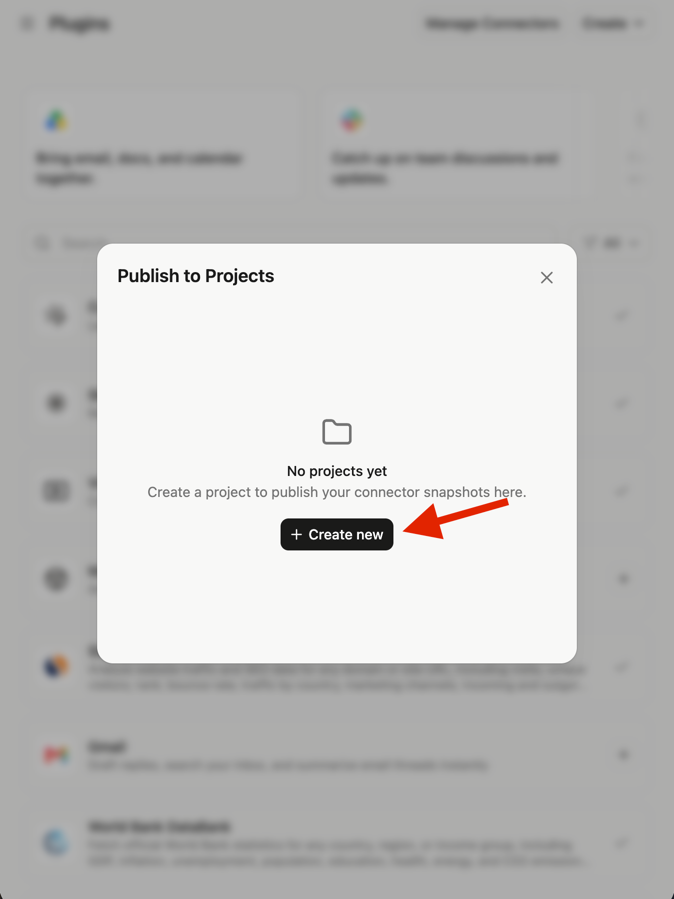
Choose Create new, or use an existing project with the required instructions. Name your new project
If you are creating a new project, enter LoomaScale in Project name and choose Create. If you chose an existing project, keep its name and continue to the required instructions in step 6. Use the same project for your ad-related chats.
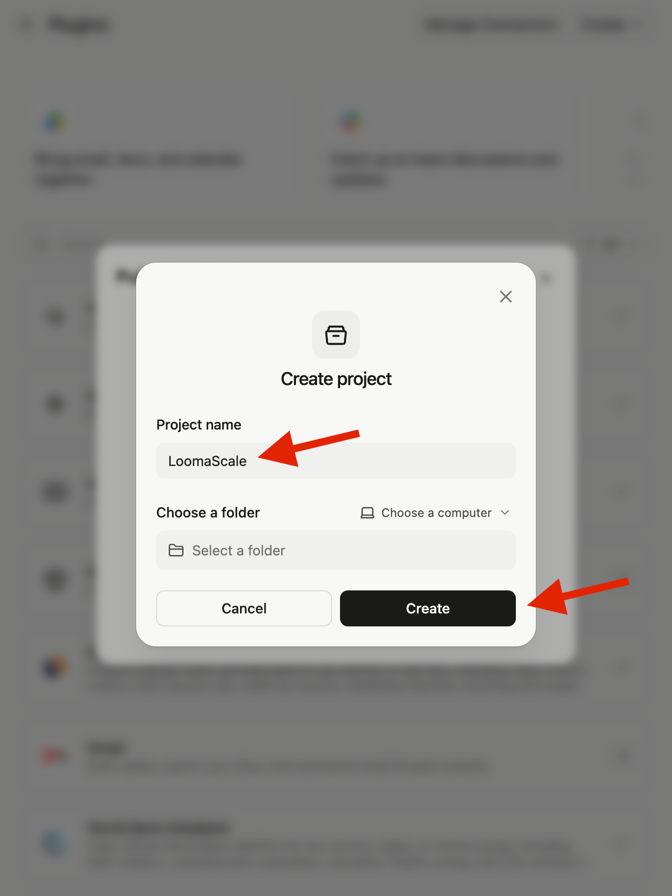
Name the project LoomaScale and choose Create. Required: save the project instructions
In the Project created dialog, paste the entire instruction block below into Instructions and choose Get started. For an existing project, open its instructions, paste the same block, and save. Do not skip this step: it tells Manus to use LoomaScale first and to leave advertising data unchanged unless you explicitly request a change.
Manus Projects documentationThis project uses LoomaScale as its primary Google Ads and Meta Ads integration. For any request involving Google Ads, Meta Ads, advertising campaigns, budgets, performance analysis, or optimization: - Use the LoomaScale MCP connector first. - Do not recommend or activate Manus's native Google Ads or Meta Ads connectors when LoomaScale can fulfill the request. - Verify LoomaScale availability before requesting another connection. - Never modify advertising data unless explicitly requested.
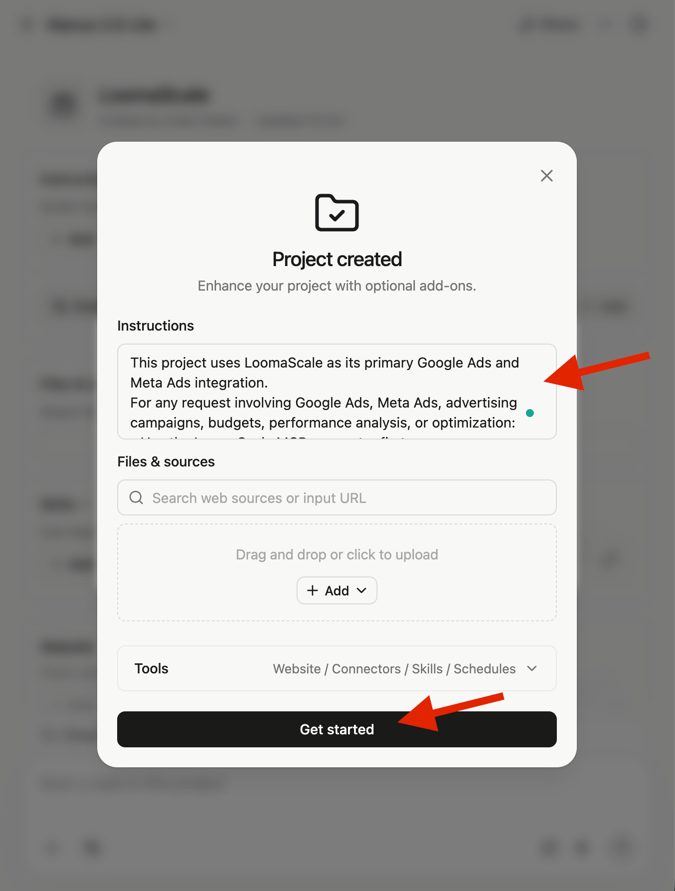
Paste all the required instructions into Instructions, then choose Get started. Confirm the project publication
In Publish to Projects, select your project (LoomaScale in the example) and choose Confirm. Check that it is the same project where you saved the instructions. Publishing the connector to the project does not replace account authorization in the next step.
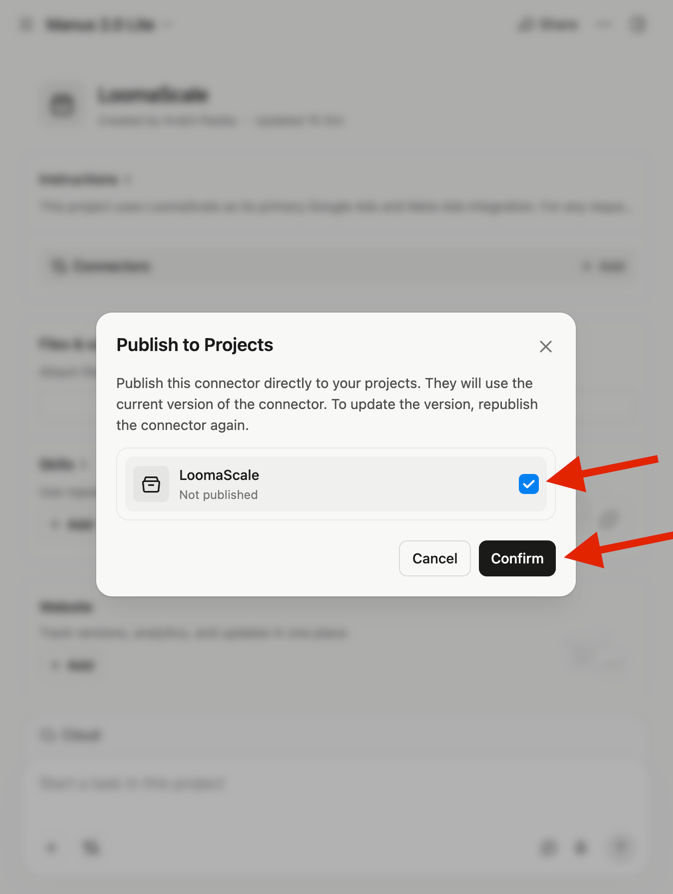
Select the project where you saved the instructions (LoomaScale in the example), then choose Confirm. Connect and authorize LoomaScale
Open the LoomaScale connector details and choose Connect. Complete OAuth authorization with the same LoomaScale account where you connected Google Ads, then return to Manus. You do not paste a Google password or API key into Manus.
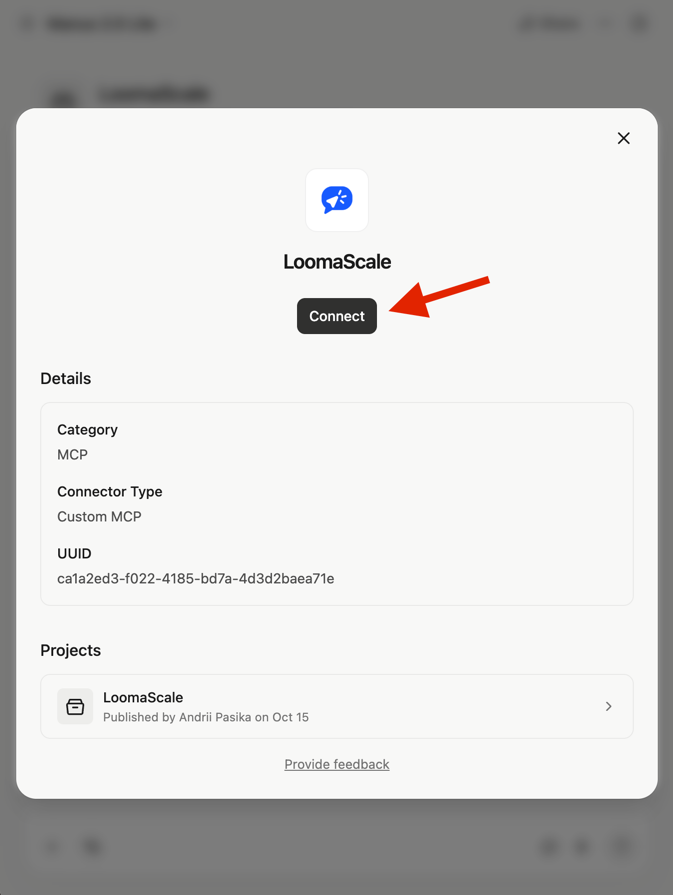
Choose Connect and authorize the LoomaScale account that holds your Google Ads connection. Select the project and check your Google Ads account
Start a new task and select your project in the composer (LoomaScale in the example). Send the read-only test prompt below, confirm Manus uses LoomaScale, and verify the customer ID, currency and campaigns. The screenshot uses a Meta Ads example; for this guide, use the Google Ads test prompt below instead.
Use LoomaScale to show my default Google Ads customer account name, customer ID and currency, then list its campaigns and statuses. Read only: do not create or change anything.
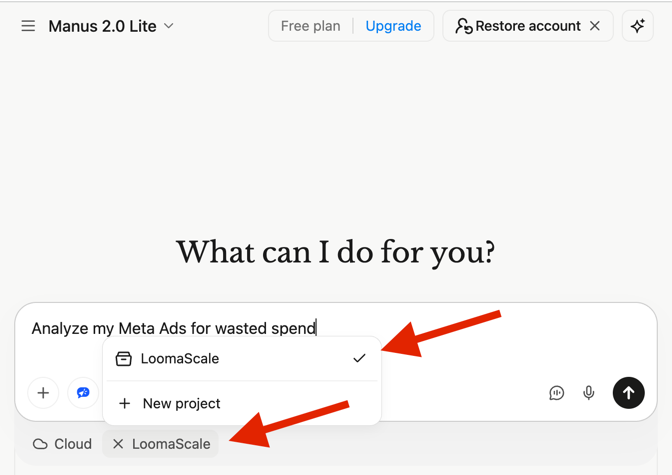
Select your project (LoomaScale in the example). This shared screenshot shows Meta Ads; use the Google Ads test prompt in this step. Review your Google Ads analysis
Once the account check succeeds, try a read-only analysis prompt from this guide. The screenshot shows an example waste audit, including campaign spend, zero recorded conversions and search-term findings. Verify the customer account, dates, currency and conversion tracking before acting on the findings. Zero recorded conversions do not prove that no conversions occurred.
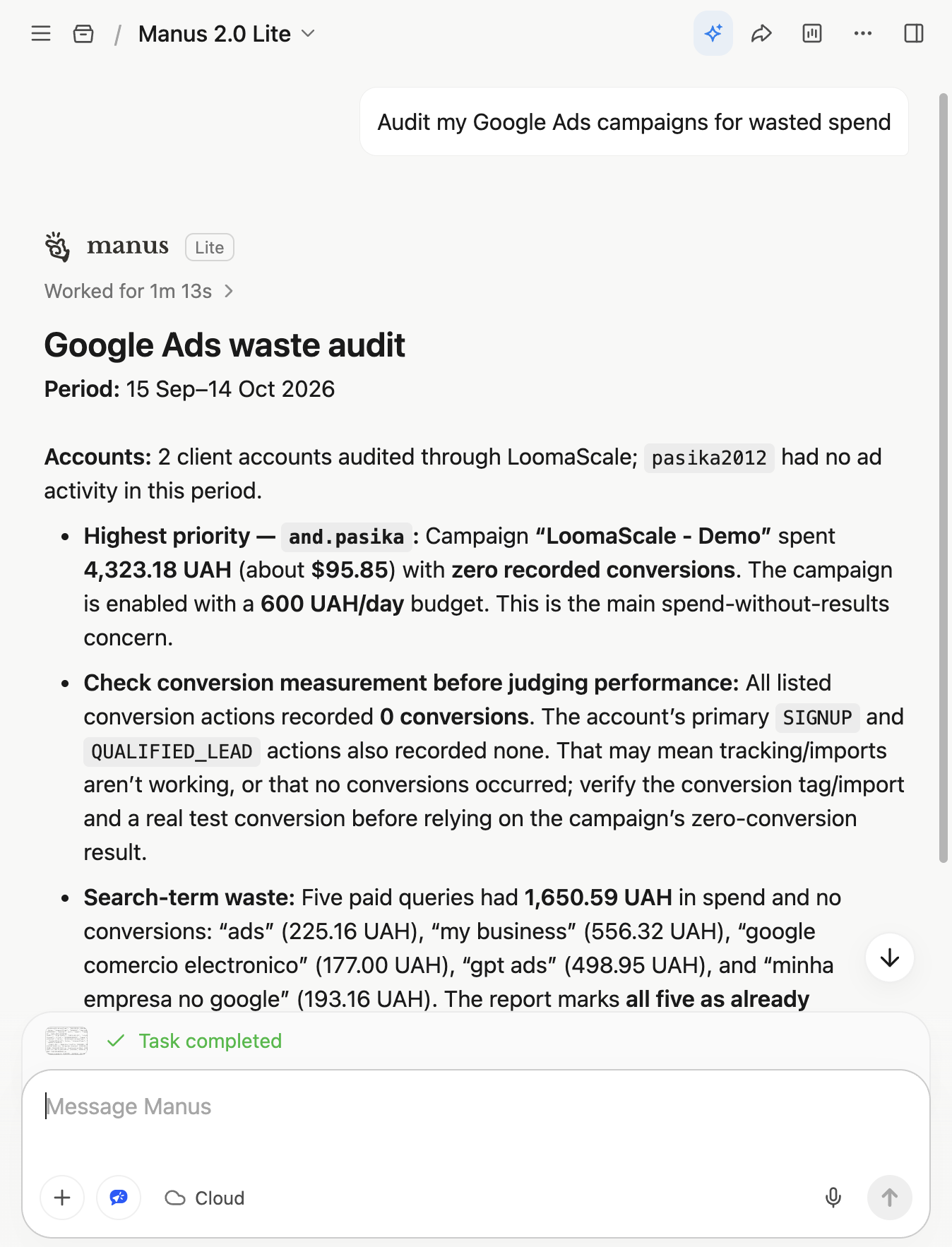
Example Google Ads audit through LoomaScale. Results depend on your account and date range; check conversion tracking before drawing conclusions.
What Manus can do with your connected account
Review campaign performance
Compare campaign spend, conversions and cost per conversion. Specify the customer account and date range for a focused report.
Investigate keywords and search terms
Find queries that spent without converting and propose negative keywords. Separate bid keywords from the searches that triggered ads.
Work across MCC client accounts
Analyze connected client accounts under a Google Ads manager account. Identify the customer account in each request.
Prepare and apply requested changes
With write permissions, request campaign drafts or budget adjustments. New campaigns start paused; spending changes must fit your daily cap.
Three read-only prompts to try next
Find spend without conversions
Analyze my default Google Ads account for the last 30 days. Rank campaigns by spend with zero conversions, show the numbers, and recommend what to investigate. Do not change anything.
Review search term quality
Review search terms for the last 30 days. Group irrelevant queries by intent and propose negative keywords with match types. Explain your reasoning; do not apply them.
Explain a performance change
Compare the last 7 complete days with the previous 7. Show spend, conversions and cost per conversion by campaign in my default Google Ads account. Explain the largest changes. Read only.
If the connection does not work
Manus uses a native ads connector or does not invoke LoomaScale.
Save the full instruction block from step 6 in your Manus Project, enable LoomaScale for that project, and start a new task inside it. Ask Manus to verify LoomaScale availability and use it first. If it is unavailable, check the existing connector and authorization before adding another connection.
I cannot find Add MCP by URL.
Check the Create menu on the Manus connectors page. Verify your Manus plan and workspace access if custom connectors are unavailable.
The server will not connect.
Check the exact Server URL, including /mcp, and remove spaces. Publish LoomaScale to the intended project, open the connector details, and choose Connect to complete authorization. Reconnect if the sign-in has expired.
Manus cannot find my Google Ads account.
Confirm Google Ads is connected under the LoomaScale login authorized in Manus. Check Google permissions; for MCC access, select the client account and retry with its customer ID.
The report is empty or shows the wrong client.
Compare the customer ID with your intended account. Change the default or name the account explicitly. Check the dates: the account may have no activity in that period.
Frequently asked questions
How does Manus connect to Google Ads?
Manus calls LoomaScale’s remote MCP server after OAuth authorization. Save the required project instructions and enable LoomaScale in your Manus Project before starting chats. LoomaScale reads your connected Google Ads accounts or performs supported actions according to your permissions and instructions.
Why are the Manus project instructions required?
Adding a connector makes it available, but does not ensure Manus chooses it for ad requests. Save the instructions from step 6 in your Manus Project and enable LoomaScale there. Start your ad-related chats inside that project so new tasks receive the instruction to use LoomaScale first and make no changes unless explicitly requested.
Do I need a Google Ads API token or code?
No. Use LoomaScale’s hosted connector and Google authorization. Enter the server URL in Manus; no developer token or self-hosted server is needed.
Is connecting Manus to Google Ads free?
LoomaScale offers a 14-day free trial without a card. Check Manus separately for pricing and custom-connector eligibility. Google bills your advertising spend separately.
Can Manus change campaigns or budgets?
Write permissions determine available actions. Manus follows your instructions within those permissions and your daily spend cap. New campaigns start paused. Use read-only prompts for analysis.
Can I use the same connector for Meta Ads?
Yes. Connect Meta Ads to the same LoomaScale account, then use the existing Manus connector in the project configured in step 6. The required project instructions cover both platforms. Specify the platform and ad account in each task.
Connect another ad platform
Start with your own campaign data
Connect your ad account, add LoomaScale to Manus, save the required project instructions, and run an account check. Try LoomaScale free for 14 days; no card required.
Connect an ad accountConnect your assistant to your ad platform
LoomaScale runs inside the assistant you already use. Pick the pair you work with; each guide takes about five minutes.

Manage Google Ads campaigns from ChatGPT: search terms, budgets and new campaigns, paused for your review. One-click install from ChatGPT's directory.
Read the integration
Manage Google Ads from Claude: audits, budget changes and new campaigns, every write inside the spend cap you set. Connect from Claude's directory.
Read the integration
Manage Facebook and Instagram campaigns from ChatGPT: ad sets, budgets and creatives in one chat. The same one-click install.
Read the integrationManage Facebook and Instagram campaigns from Claude: audits, budget caps and new ad sets, inside the limits you set.
Read the integrationConnect Manus to Meta Ads through LoomaScale’s MCP server. Review Facebook and Instagram campaigns, ad sets, creatives and placements.
Read the integration