
What is AI ads optimization?
AI ads optimization is the use of AI to analyze campaign data and improve decisions about bids, budgets, audiences, search terms, and creative. The useful outcome is more valuable business results for the money spent. Generating more ad variations is only one possible input to that process.
For a store, the goal might be profitable purchases. For a service business, it might be qualified appointments. An assistant needs that distinction: a cheap form submission and a paying customer are different outcomes.
This guide focuses on measuring and testing improvements across Google Ads and Meta Ads. For seven account-level tasks and prompts, use the Google Ads PPC optimization guide. For tool selection, client briefs, and team responsibilities, read AI PPC management for agencies.
What must you measure before optimizing across Google and Meta?
A recommendation to move budget needs a comparable outcome. Start with the same definition of a qualified lead or purchase, a consistent reporting period, and an explicit source for each metric. If the accounts use different currencies, document how you convert them before comparing costs.
Google's Smart Bidding and Meta's automation tools optimize delivery within their respective platforms. An assistant can compare the reports you provide or connect, but it cannot resolve missing customer records by guessing.
| Evidence layer | What it answers | What it does not establish |
|---|---|---|
| Platform report | What Google or Meta attributed under its settings | That all conversions are unique across platforms |
| Deduplicated CRM or order records | How many distinct qualified leads or purchases you recorded | That advertising caused every recorded outcome |
| Controlled experiment | Whether a tested change improved the selected outcome under the test conditions | That it will work unchanged at any budget |
How do you test AI ads optimization across channels?
Step 1: Define the result before changing the campaign
Choose one primary business metric. Use cost per qualified lead for lead generation, or conversion value relative to ad spend for an ecommerce campaign. Add a volume constraint: reducing cost per lead is less useful if the campaign stops generating enough leads.
Record the account, currency, time zone, conversion action, attribution settings, and comparison dates. Check for duplicate purchase events, missing values, and forms counted as sales. If qualification data lives in your CRM, bring an appropriate aggregate into the analysis; do not assume an assistant can see it in the ad account.
Step 2: Establish a baseline with complete data
Compare equivalent periods and account for promotions, tracking changes, and seasonality. A recent day with few reported conversions can look worse simply because customers have not converted yet.
Google's bid strategy testing guidance recommends isolating variables and accounting for conversion delay. A weekly review can surface questions; it does not mean every experiment should finish in seven days.
Ask the assistant to distinguish observations from hypotheses. “Cost rose 15%” is an observation if the report supports it. “The audience is exhausted” needs additional evidence.
Step 3: Identify the constraint before choosing a channel
A lower platform CPA can reflect a different conversion definition or a different mix of customers. Separate acquisition from remarketing and new from returning customers where the data supports it. Record any segment you cannot compare instead of treating it as equivalent.
For a creative experiment, name the audience, offer, and message being tested. A message that works for someone actively searching for a service may perform differently in a social feed. Treat each channel's response as evidence for that context.
For Google-specific search-term and bidding checks, use the seven-task Google Ads optimization guide.
Step 4: Write the experiment before applying the change
Specify the hypothesis, baseline, test variable, business metric, and reversal condition. For example: test a new offer message on Meta while holding the landing page and budget stable. Decide how the comparison will work and when enough conversion data should be available.
Changing budget, creative, and targeting together makes interpretation harder. Use a platform experiment where available if you need stronger evidence than a before-and-after comparison. For changes spanning platforms, define the comparison design explicitly; two unrelated dashboard totals are not a controlled test.
Review the proposed settings and spending limit before applying changes. An instruction in a prompt is not a substitute for checking platform settings and tool permissions.
Step 5: Evaluate, record, and repeat
After the relevant conversion delay, compare the primary metric and total outcomes with the baseline. Check whether a promotion, tracking fix, or change in lead qualification could explain the result. Before-and-after movement alone does not establish that AI caused an improvement.
Keep a short decision log: date, evidence, change, owner, review date, and result. Retain changes supported by the evidence; reverse those that undermine the business goal. If data is too sparse, record the uncertainty instead of manufacturing a winner.
How should you compare CPA and ROAS across channels?
| Metric | Calculation | Main limitation |
|---|---|---|
| CPA | Ad spend ÷ tracked conversions | Depends on what you count as a conversion |
| Cost per qualified lead | Ad spend ÷ qualified leads | Requires consistent qualification |
| ROAS | Attributed conversion value ÷ ad spend | Measures attributed value, not profit or incrementality |
| Conversion rate | Conversions ÷ the stated interaction denominator | Comparisons need the same definition |
Illustrative example, not a LoomaScale customer result: a Google campaign and a Meta campaign each spend $600. Using one CRM attribution rule to assign each unique lead to a channel, Google receives credit for 30 leads, of which 6 qualify, and Meta for 20, of which 10 qualify. Google has the lower raw cost per lead ($20 versus $30), but Meta has the lower cost per qualified lead ($60 versus $100).
That makes Meta worth investigating for additional budget. It does not prove Meta can scale at the same efficiency. Compare a mature reporting period, verify qualification, and test an increase within an agreed limit.
Example: when CPA and ROAS cannot guide a budget decision
This reporting check in ChatGPT compares Google Ads and Meta Ads for September 13–October 12, 2026. The screenshot shows 3,934.51 UAH in Google Ads spend with zero recorded conversions, and $622.27 in Meta Ads spend with zero recorded purchases. Google’s configured conversion metric and Meta purchases are different measures; other Meta actions may exist outside this comparison.
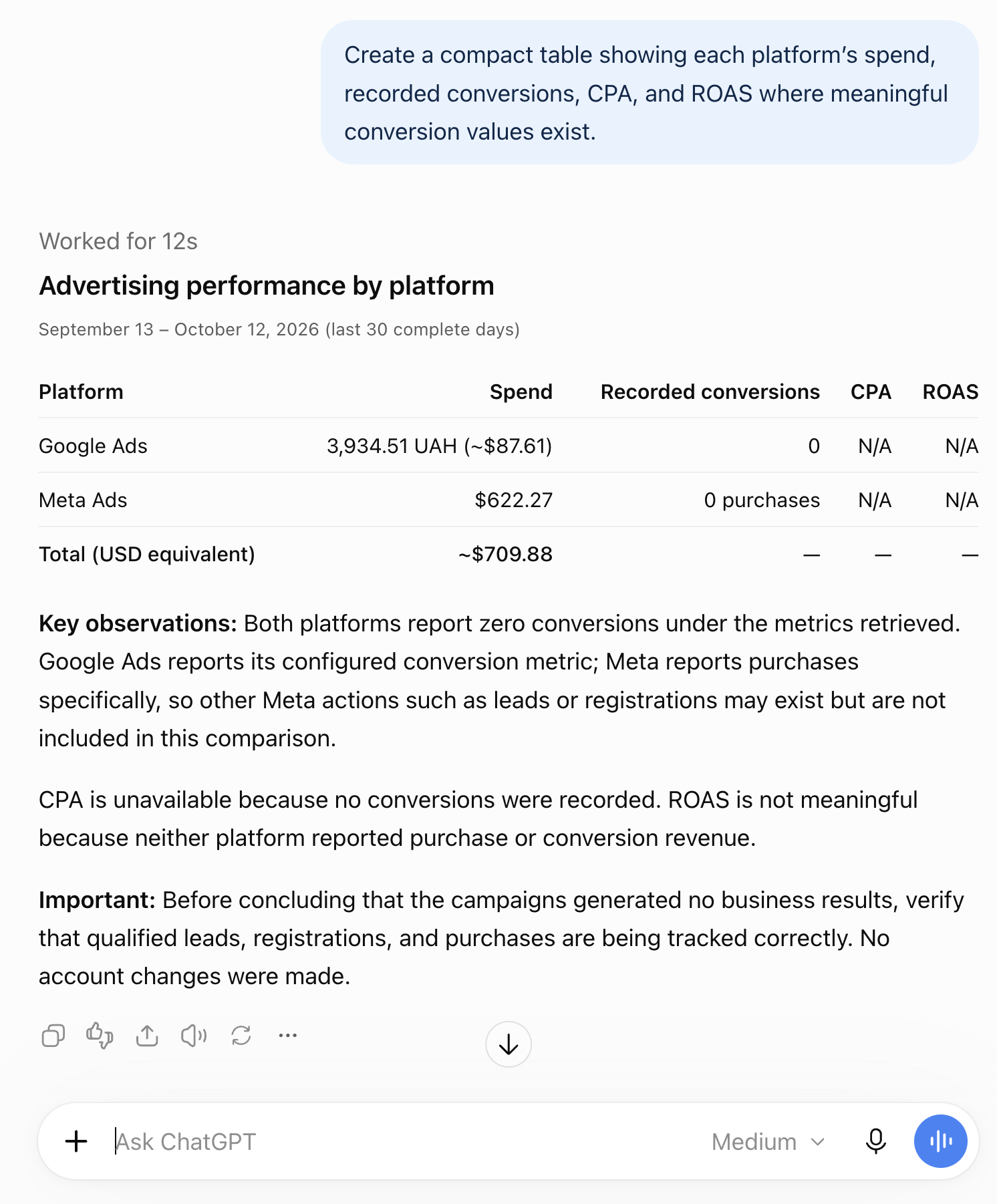
CPA and ROAS appear as N/A. The useful next step is to verify tracking and align outcome definitions before reallocating budget. This report does not establish that the campaigns generated no business results. Its USD-equivalent spend total is approximate, and the exchange-rate source and date are not visible; verify them before using that total to reconcile spending.
How do you avoid double-counting conversions?
Keep platform-reported results in separate columns. Reconcile the business total using a stable order or lead identifier where your measurement setup allows it. Document the attribution rule used to assign a record to a channel; deduplicating records and assigning credit are different operations.
If Google reports 12 purchases and Meta reports 10, you cannot conclude there were 22 unique purchases. Nor can you infer which channel caused a sale from the platform totals alone. Ask the assistant to identify that gap and list the data needed to resolve it.
A deduplicated total is still not a measure of incremental sales: some customers may have bought without the advertising. If the decision requires a causal claim, design an appropriate controlled experiment instead of treating attributed ROAS as proof.
When should you move budget between Google and Meta?
First verify that the outcome definitions, reporting windows, currency, and qualification rules are comparable. Then form a hypothesis about the next increment of spend. A channel's historical average CPA does not tell you what its next qualified lead will cost.
Set the amount you are willing to test, hold total spend within an agreed limit, and define the main outcome plus a volume constraint. Record promotions, audience changes, and landing-page changes that could affect the comparison. Review mature results before repeating the move.
The decision can be to leave allocation unchanged. Missing sales data or a handful of conversions is a reason to improve measurement or collect more evidence, rather than declare a winning channel.
A prompt for an AI ads optimization experiment
Use this after supplying comparable channel reports and any relevant CRM or order totals. Replace the brackets and identify data the assistant cannot access.
Compare Google Ads and Meta Ads for [period] using [business outcome]. Target: [qualified-lead CPA or purchase ROAS]. Total test budget limit: [amount]. State each source's currency, time zone, attribution and conversion definitions. Keep platform-reported conversions separate from deduplicated business outcomes. Flag mismatched periods, conversion delay, missing qualification and duplicates. Propose one budget-allocation or creative experiment, not a list of account edits. Specify hypothesis, baseline, test variable, success metric, volume constraint, evaluation period and reversal condition. State what the test cannot prove. If the evidence is insufficient, list the missing data. Do not apply changes.
How does LoomaScale fit into the workflow?
LoomaScale connects Google Ads and Meta Ads to assistants such as ChatGPT and Claude. It gives you a way to bring connected account data into the conversation and work with the actions exposed by the integration. It complements the platforms' own delivery and bidding systems.
Connect the relevant accounts using the Google Ads setup guide and Meta Ads setup guide. Check supported reports and operations in the LoomaScale documentation, then supply business records that the connection cannot access. Use the experiment prompt above once the reporting definitions are comparable.
For Google account-level diagnosis, continue with the Google Ads PPC optimization guide. The outcome of this measurement process is a documented decision: fix the data, test a specific change, or keep the current allocation until more evidence arrives.